
The Naz Foundation Case UPSC is one of the most important topics for students preparing for the Civil Services Examination. It represents a turning point in Indian constitutional history where the judiciary examined colonial laws through the lens of fundamental rights, dignity, and personal liberty.
The Naz Foundation Case UPSC is not limited to LGBTQ rights alone. It is a broader constitutional story about equality, privacy, public health, and the role of courts in protecting minorities. This is why the Naz Foundation Case UPSC is frequently referenced in GS Paper II, Ethics answers, and essay writing.
What Is the Naz Foundation Case UPSC
The Naz Foundation Case UPSC refers to Naz Foundation (India) Trust v. Government of NCT of Delhi (2009), decided by the Delhi High Court. The case challenged the constitutional validity of Section 377 of the Indian Penal Code, 1860.
For UPSC aspirants, understanding the Naz Foundation Case UPSC means understanding how courts interpret Articles 14, 15, 19, and 21 of the Constitution in real-life situations. The judgment questioned whether the state could criminalise private, consensual acts between adults.
About Naz Foundation (India) Trust
To fully understand the Naz Foundation Case UPSC, it is important to know about Naz Foundation (India) Trust. It is a non-governmental organisation established in 1994, working mainly in HIV/AIDS prevention and sexual health awareness.
While working at the grassroots level, the organisation observed that Section 377 created fear and stigma. This directly affected healthcare access, which later became a major argument in the Naz Foundation Case UPSC.
Naz Foundation Case UPSC – Bio Table
| Field | Details |
|---|---|
| Case Name | Naz Foundation (India) Trust v. Government of NCT of Delhi |
| Popular As | Naz Foundation Case UPSC |
| Year of Judgment | 2009 |
| Court | Delhi High Court |
| Law Challenged | Section 377, Indian Penal Code (IPC) |
| Filed By | Naz Foundation (India) Trust |
| Case Type | Public Interest Litigation (PIL) |
| Main Issue | Criminalisation of consensual same-sex relations |
| Articles Involved | Articles 14, 15, 19, and 21 |
| Judgment Outcome | Section 377 read down for consenting adults |
| Legal Significance | Expansion of equality, dignity, and privacy |
| UPSC Relevance | GS Paper II, Ethics, Essay |
Historical Background of Section 377
The Naz Foundation Case UPSC revolves around Section 377, a colonial law introduced during British rule. The provision reflected Victorian morality rather than constitutional values of modern India.
Section 377 did not distinguish between consensual and non-consensual acts. This broad criminalisation became one of the central issues discussed in the Naz Foundation Case UPSC.
Why the Naz Foundation Case UPSC Was Filed
The Naz Foundation Case UPSC was filed as a Public Interest Litigation. The petition argued that Section 377 violated multiple fundamental rights.
According to the petitioners, the law:
- Encouraged police misuse
- Increased social discrimination
- Restricted personal liberty
- Harmed public health efforts
These arguments formed the backbone of the Naz Foundation Case UPSC.
Constitutional Articles Involved
One of the reasons the Naz Foundation Case UPSC is so important is its deep constitutional analysis.
Under Article 14, the court examined whether Section 377 created unreasonable classification.
Under Article 15, the Naz Foundation Case UPSC argued that discrimination based on sexual orientation falls within discrimination based on sex.
Under Article 19, the case highlighted restrictions on expression and identity.
Under Article 21, the Naz Foundation Case UPSC stressed privacy, dignity, and autonomy as essential parts of life and liberty.
Delhi High Court Judgment (2009)
In July 2009, the Delhi High Court delivered a historic judgment in the Naz Foundation Case UPSC.
The court held that Section 377 is unconstitutional to the extent that it criminalises consensual sexual acts between adults in private. The judgment clearly stated that moral disapproval cannot justify criminal punishment.
This ruling made the Naz Foundation Case UPSC a milestone in Indian human rights law.
Concept of Constitutional Morality
A key contribution of the Naz Foundation Case UPSC was its emphasis on constitutional morality. The court stated that popular morality cannot override constitutional principles.
This idea later influenced many Supreme Court judgments, which is why the Naz Foundation Case UPSC is often quoted in Ethics and Polity answers.
Public Health Perspective
The Naz Foundation Case UPSC strongly linked law with public health. Criminalisation under Section 377 forced vulnerable communities into secrecy.
The court recognised that effective HIV prevention cannot succeed in an atmosphere of fear. This practical reasoning strengthened the importance of the Naz Foundation Case UPSC.
Supreme Court Reversal in 2013
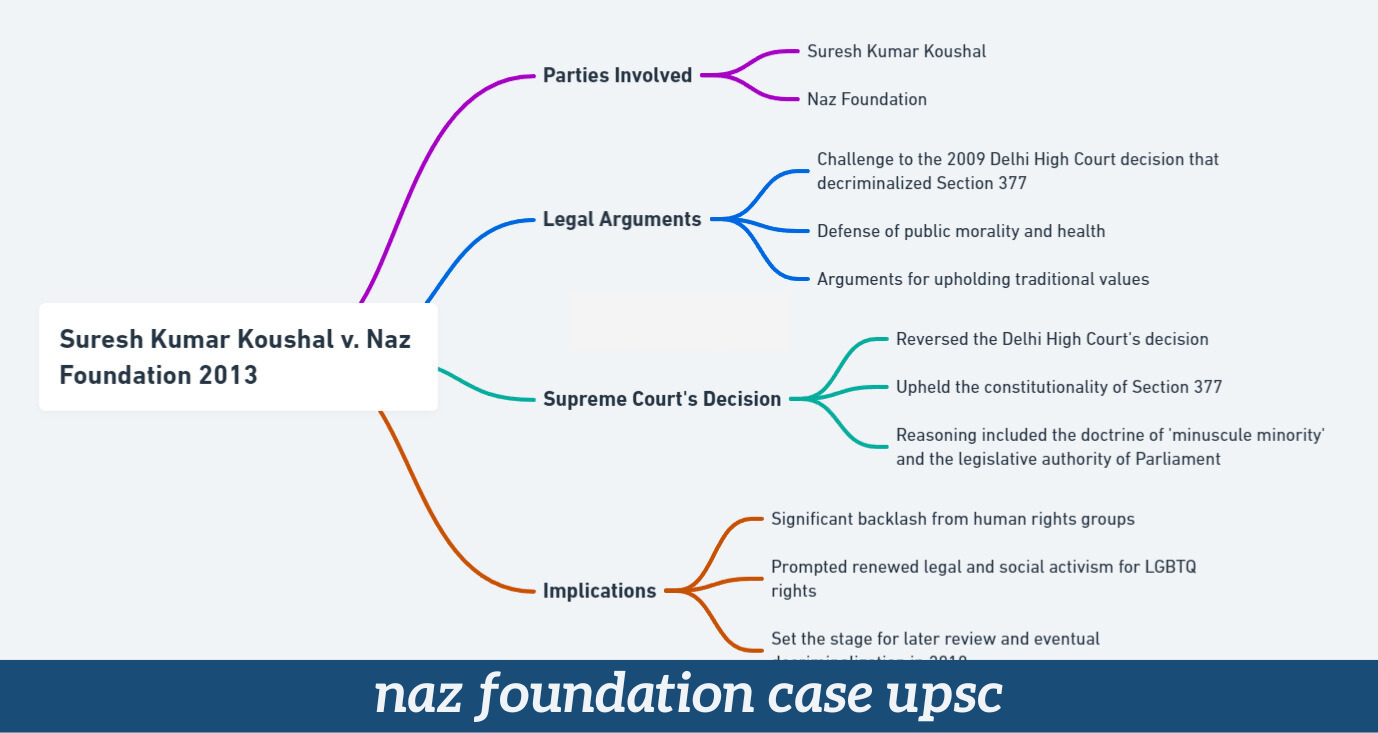
In Suresh Kumar Koushal v. Naz Foundation (2013), the Supreme Court overturned the Delhi High Court decision.
This reversal temporarily weakened the impact of the Naz Foundation Case UPSC, but it also sparked nationwide debate on constitutional morality and minority rights.
Final Outcome in Navtej Singh Johar Case (2018)
In 2018, the Supreme Court finally decriminalised consensual same-sex relationships in Navtej Singh Johar v. Union of India.
The reasoning of the Naz Foundation Case UPSC played a crucial role in shaping this final judgment. The Court restored dignity, equality, and privacy as constitutional values.
Relevance of Naz Foundation Case UPSC for Aspirants
For UPSC aspirants, the Naz Foundation Case UPSC is important because it demonstrates:
- Judicial review of colonial laws
- Expansion of fundamental rights
- Protection of minority interests
- Role of constitutional morality
This makes the Naz Foundation Case UPSC highly relevant for GS Paper II and Ethics case studies.
Clarification on Personal Details
Details such as age, height, family, net worth, or physical appearance are not applicable in the Naz Foundation Case UPSC, as it concerns a legal judgment and an organisation, not an individual personality.
Clarifying this maintains academic accuracy and professionalism.
Social Role and Public Presence
Naz Foundation continues its work in healthcare awareness and advocacy. Its role after the Naz Foundation Case UPSC reflects how civil society organisations contribute to constitutional change.
Conclusion
The Naz Foundation Case UPSC reshaped Indian constitutional interpretation. It challenged colonial morality, strengthened personal liberty, and laid the foundation for equality and dignity in modern India.
For UPSC preparation and beyond, the Naz Foundation Case UPSC remains a powerful example of how the Constitution evolves to protect human freedom and justice.
FAQs
Q: What is the Naz Foundation Case UPSC?
A: The Naz Foundation Case UPSC refers to the 2009 Delhi High Court judgment that read down Section 377 IPC, decriminalising consensual same-sex relations between adults.
Q: Why is the Naz Foundation Case UPSC important for UPSC exams?
A: The Naz Foundation Case UPSC is important because it explains constitutional morality, judicial review, and the interpretation of fundamental rights under Articles 14, 15, 19, and 21.
Q: Which law was challenged in the Naz Foundation Case UPSC?
A: Section 377 of the Indian Penal Code, a colonial-era law criminalising “unnatural offences,” was challenged in the Naz Foundation Case UPSC.
Q: What was the Delhi High Court’s decision in the Naz Foundation Case UPSC?
A: The Delhi High Court ruled that Section 377 is unconstitutional to the extent that it criminalises consensual sexual acts between adults in private.
Q: How did the Naz Foundation Case UPSC influence later judgments?
A: The Naz Foundation Case UPSC laid the legal foundation for the Supreme Court’s 2018 Navtej Singh Johar judgment, which fully decriminalised consensual same-sex relationships.
