
What Is the Mehngai Rahat Camp?
Mehngai Rahat Camp is a state‑government initiative launched by the Rajasthan government under Chief Minister Ashok Gehlot, designed to help ordinary people cope with rising inflation. The name itself means “inflation relief camp” (mehngai = inflation, rahat = relief). Through these camps, the government connects citizens with welfare schemes and gives them a way to register and access benefits immediately. mint+2The Times of India+2
In a historic step, around 2,700 such camps were planned across the state, including 2,000 permanent camps at government offices or public places. The Economic Times+1 Two‑day camps are also organized in every gram panchayat and urban ward to ensure local reach. mint+1 The first camp was inaugurated on 24 April 2023 at Mahapura village in Sanganer, Jaipur. mint The initial phase was set to run until 30 June 2023. The Times of India
Why It Was Launched: The Purpose
The core idea behind the Mehngai Rahat Camp is to empower people, especially the economically vulnerable, by giving them transparent access to state welfare. Many individuals don’t know which government schemes they qualify for, or how to apply — these camps act as a bridge. Web India News+1
By bringing together multiple welfare programs under one roof, the government hopes to ease the burden of inflation on essentials like food, electricity, gas, and healthcare. As Gehlot himself put it, the goal is to ensure no needy person in the state is “deprived of registration” for the key schemes. The Times of India
Also, by offering on-the-spot registration and even giving out a “Mukhyamantri Guarantee Card” right there in the camp, the government makes the process of accessing these benefits much smoother. Business Standard+1
What Benefits Does the Camp Provide?
One of the most important features of the Mehngai Rahat Camp is that it links people to ten major welfare schemes. These are some of the key benefits offered through the camps:
- Cheap LPG Gas Cylinder: Under the Mukhyamantri Gas Cylinder Yojana, beneficiaries can get a cylinder for just ₹ 500. Business Standard+1
- Free Electricity for Households: Domestic electricity consumers can get 100 units free per month via the Nishulk Bijli Yojana. Business Standard
- Free Electricity for Farmers: Under a special agricultural electricity plan (Mukhyamantri Nishulk Krishi Bijli Yojana), farmers may receive up to 2,000 units free every month. Business Standard
- Free Food Packets: For people under the National Food Security framework, the camp facilitates registration for the Mukhyamantri Nishulk Annapurna Food Packet Scheme, providing food packets monthly. The Times of India
- Rural Employment Guarantee: Through the Mahatma Gandhi NREGA-linked scheme, rural families are promised additional days of work. Business Standard
- Urban Employment Guarantee: The Indira Gandhi Shehri Rozgar Guarantee Yojana offers up to 125 days of paid work in urban areas. Business Standard
- Social Security Pension: Under the Samajik Suraksha Pension Yojana, eligible people (such as the elderly or those in need) can get at least ₹ 1,000 per month. The Times of India
- Health Insurance: The Chief Minister Chiranjeevi Health Insurance Scheme has a cover that has been increased to ₹ 25 lakh, making it more powerful for serious medical cases. The Economic Times
- Accidental Insurance: The Chiranjeevi Accidental Insurance Scheme provides up to ₹ 10 lakh cover for accidents. The Economic Times
- Livestock Insurance: Under the Mukhyamantri Kamdhenu Pashu Bima Yojana, milch cattle are insured for up to ₹ 40,000 per animal, for up to two cattle per owner. Business Standard
| Scheme / Benefit | Description | Eligibility / Notes |
|---|
| Gas Cylinder Subsidy | LPG cylinder at subsidized rate (₹500) | Low-income families with Ujjwala connection |
| Free Household Electricity | 100 units free per month | Domestic electricity consumers in Rajasthan |
| Free Agricultural Electricity | Up to 2,000 units for farmers | Farmers with registered agriculture electricity connections |
| Free Food Packets | Monthly food packets under Mukhyamantri Annapurna Scheme | Eligible residents facing food insecurity |
| Rural Employment Guarantee | Paid work up to 125 days | Rural families under NREGA-linked scheme |
| Urban Employment Guarantee | Paid work up to 125 days | Urban residents under Indira Gandhi Shehri Rozgar Guarantee |
| Social Security Pension | Minimum ₹1,000 per month | Elderly, disabled, or needy individuals |
| Health Insurance | Coverage up to ₹25 lakh | Beneficiaries under Chiranjeevi Health Insurance Scheme |
| Accidental Insurance | Coverage up to ₹10 lakh | Eligible residents under Chiranjeevi Accidental Insurance Scheme |
| Livestock Insurance | Up to ₹40,000 per milch cattle | Cattle owners under Mukhyamantri Kamdhenu Pashu Bima Yojana |
| Mukhyamantri Guarantee Card | Registration card for easy access | Issued at camp after registration |
How the Camps Work
These Mehngai Rahat Camp run daily from 10 AM to 6 PM, making them accessible for many people. The Economic Times When someone visits, they can register for the welfare schemes, and after verifying their eligibility, they often receive the Mukhyamantri Guarantee Card right there in the camp. Business Standard
What’s more, the camps are not limited by district — you can go to a camp in any district and register, as long as you have a Jan Aadhar Card. mint In total, the state has distributed a massive number of these Guarantee Cards: 3 crore cards have reportedly been given out through the Mehngai Rahat Camps, according to the CM’s office. Outlook India
The government also set aside ₹592 crore in its budget under various welfare provisions tied to these camps, underlining how seriously the initiative is being funded. mint
Public Response & Impact
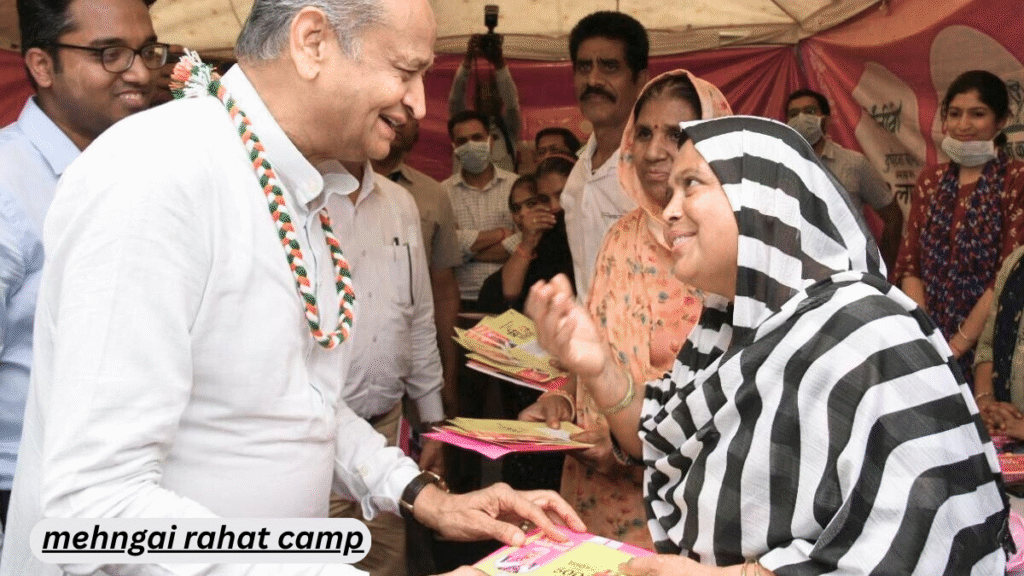
From the moment it launched, the Mehngai Rahat Camp drew a very positive response from the public. On the first day itself, around 650,000 people reportedly registered for various welfare schemes. Business Standard That shows how much demand there is for support in a time of rising prices.
On the political front, critics have noted that the timing of these camps aligns with the run-up to elections — some see it as a way for the government to build goodwill by tackling inflation head-on. The Times of India Still, many residents genuinely welcome the relief, especially in more rural or low-income communities where inflation hits hardest.
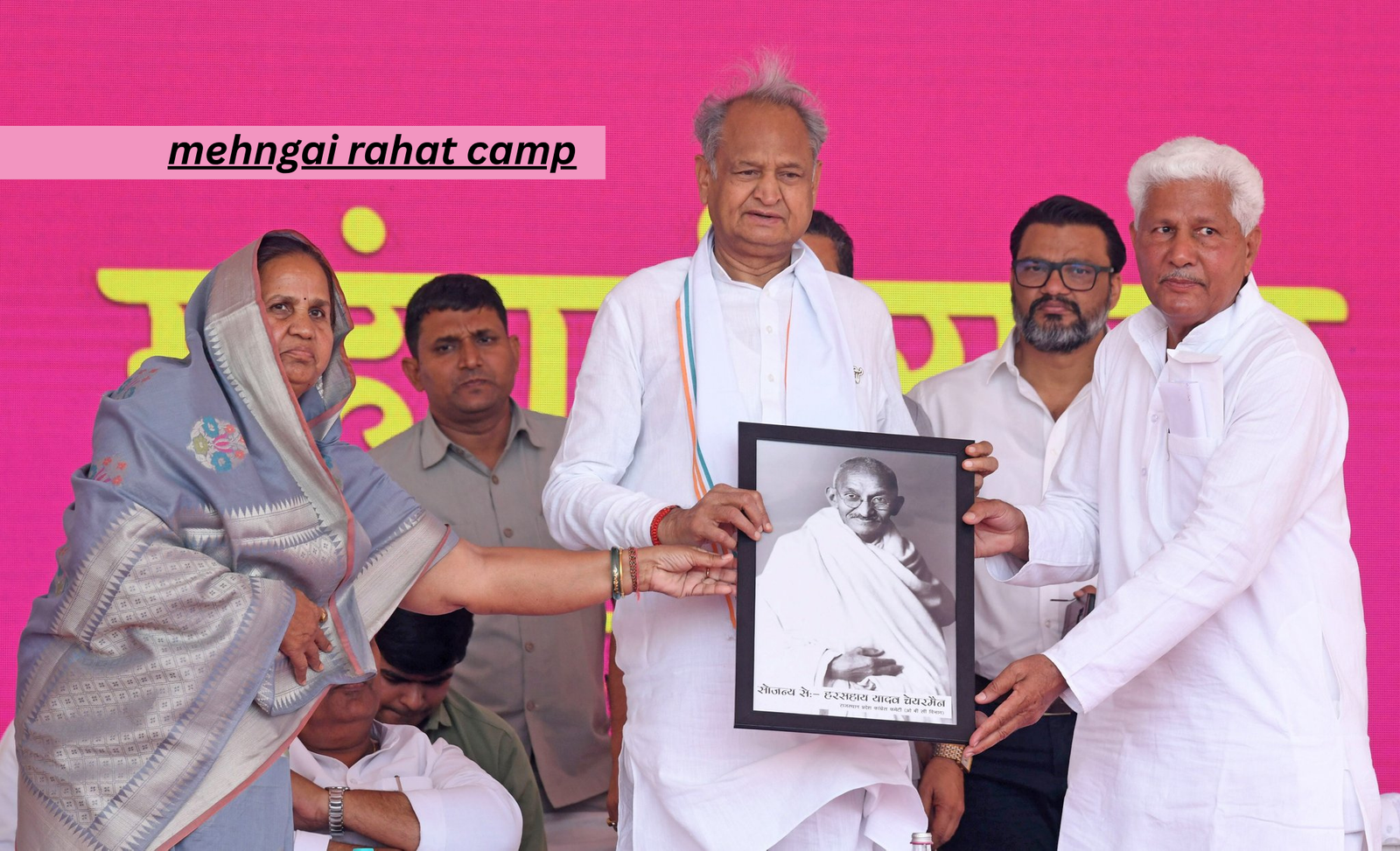
Visually, the initiative has been very visible: large pink posters and banners promoting the Mehngai Rahat Camps have sprung up in cities like Jaipur, making it clear the government is pushing this message hard. Deccan Chronicle
Challenges & Criticisms
No initiative is without its challenges, and the Mehngai Rahat Camp is no different. Some of the main criticisms include:
- Political Motive: Given its scale and timing, many argue this camp is partly driven by electoral strategy, not just welfare. The Times of India+1
- Sustainability: While the camps run until June 2023 in the first phase, the long-term question is whether such high-touch welfare can be maintained indefinitely.
- Awareness and Access: Even though these camps are widespread, there’s always a risk that the poorest or most isolated people might not reach them, or may not fully understand what’s on offer.
- Administrative Load: Running thousands of camps, verifying eligibility, issuing Guarantee Cards, and tracking outcomes is a huge administrative burden.
- Benefit Realization: Registering is one thing; actually receiving all promised benefits (like gas cylinders or insurance payout) depends on follow-through and efficient governance.
Why Mehngai Rahat Camp Matters
Social Impact: By lowering the barrier to access for major welfare schemes, this initiative has the potential to directly improve the lives of millions. For many families, a ₹ 500 LPG cylinder, free electricity, or health coverage can make a big difference.
Government Trust: When a government sets up visible, physical camps and offers on‑the-spot support, it builds trust. People see action, not just promises.
Policy Innovation: This camp can be seen as a model for how states can fight inflation in a targeted, welfare‑oriented way. Rather than a blanket subsidy, it links inflation relief with existing schemes while making the system more inclusive.
Political Signaling: Whether or not one agrees with the political motives, there is no denying that such a visible and popular program sends a strong message — that the government is aware of inflation pains and is actively addressing them.
Future Outlook & What to Watch For
As of now, the initial public phase (Apr–June 2023) was the most visible. But going forward, what matters most is impact measurement. Will registered people actually receive all the promised benefits? Will the Guarantee Card lead to sustained welfare uptake, or is it just a registration tool?
Another key question is scale-up: Will the government keep enough permanent camps running, or scale them down after the initial burst? And how will the government manage the financial pressure if demand stays high?
Also, digital integration could play a major role. Linking these camps to state databases (like Jan Aadhar) and making follow-up easier via mobile apps or regular outreach could make the scheme more efficient.
In Conclusion
The Mehngai Rahat Camp is arguably one of the boldest welfare initiatives by the Rajasthan government in response to inflation. By offering a one-stop shop for 10 major welfare schemes, the camp is not just about giving handouts — it’s about connecting people to long-term social security programs.
If implemented well, this camp could reduce economic stress, especially in rural and low-income communities. But success will hinge on follow-through: making sure that the registered individuals receive their benefits, that camps remain accessible, and that the initiative does not just fade once the political spotlight shifts.
For the common person in Rajasthan, Mehngai Rahat Camp is more than just a slogan — it’s a real window of hope in difficult times.
FAQs
Q: What is Mehngai Rahat Camp?
A: Mehngai Rahat Camp is a Rajasthan government initiative to help people access welfare schemes and get relief from rising prices.
Q: Who can benefit from Mehngai Rahat Camp?
A: Residents of Rajasthan with a Jan Aadhar Card, especially low-income families, farmers, and marginalized communities, can benefit.
Q: What benefits are offered at the Mehngai Rahat Camp?
A: Benefits include subsidized gas cylinders, free electricity, food packets, pensions, health and accident insurance, employment guarantees, and livestock insurance.
Q: How can people register for the schemes?
A: People can visit the camps in person, provide their Jan Aadhar Card, and officials assist with registration and verification.
Q: Are Mehngai Rahat Camps temporary or permanent?
A: The state has set up both permanent camps at government offices and temporary two-day camps in villages and urban wards for wider reach.
